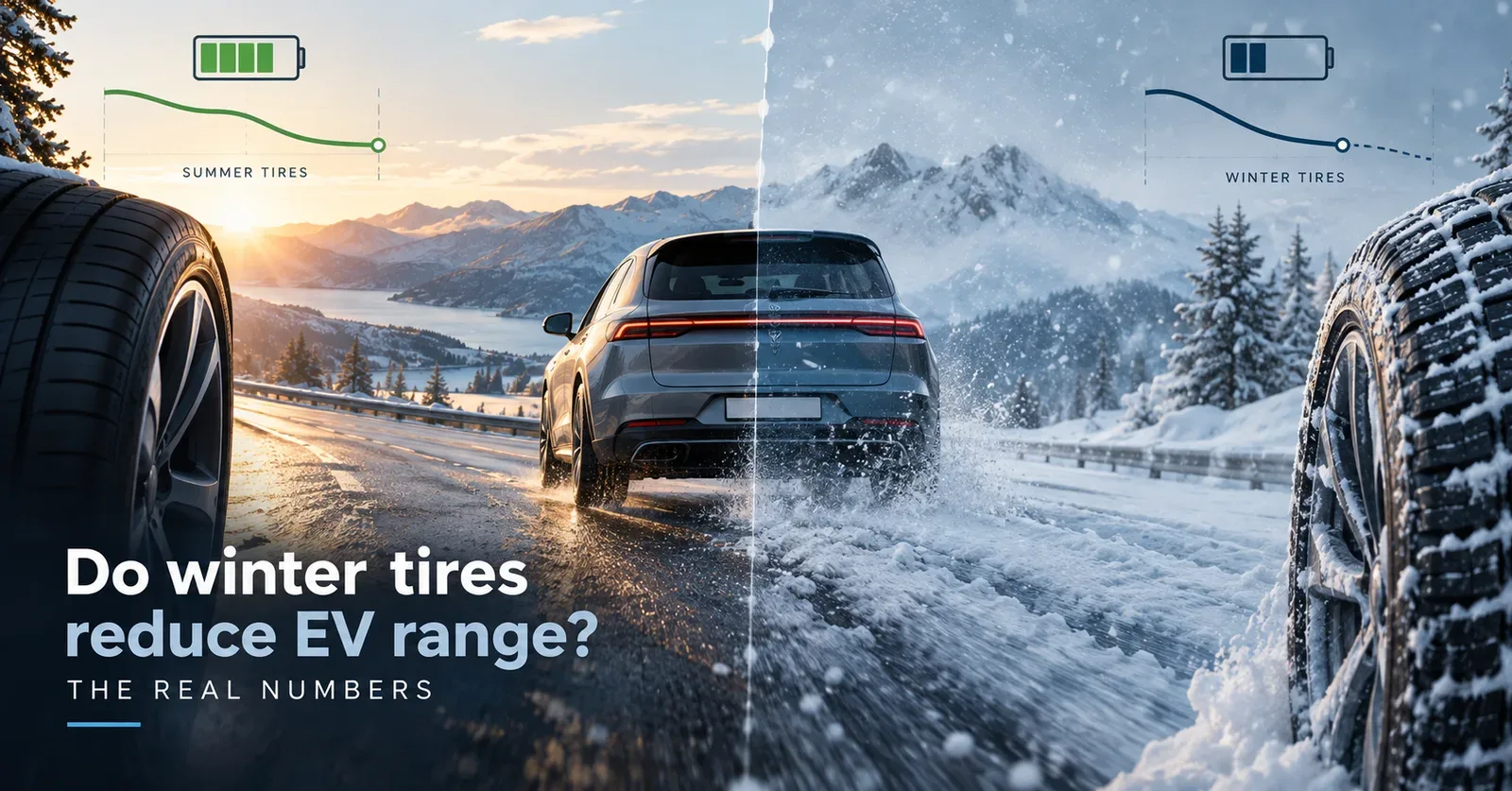
Switching to winter tires is one of those decisions EV owners make every year without thinking much about the numbers. The tires go on, the weather gets colder and the car starts using more energy. But how much of that extra consumption comes from the tires? It is harder to answer than it might seem. Winter tires have different rolling characteristics from summer tires, but cold weather affects several other parts of an electric car at the same time. The battery may deliver less usable energy, the cabin heater draws power and wet or snowy roads can increase energy consumption further.
01Winter tires have a cost in energy
A tire loses some energy as it deforms against the road. This is known as rolling resistance and the motor has to overcome it whenever the car moves. The rubber compound, tread pattern, tire pressure and temperature all influence how much energy is lost. Winter tires are designed to maintain grip in cold conditions, often using softer compounds and tread patterns suited to snow and slush. Depending on the particular tires being compared, these characteristics can affect rolling resistance. The important distinction is that not all winter tires behave the same way. A premium winter tire designed for efficiency may perform differently from a tire optimized primarily for snow and ice grip. The dimensions and construction of the tire matter, too. For an EV, even a modest increase in energy consumption can become noticeable over a long journey. A car that normally uses 200 Wh/km, for example, consumes 20 kWh over 100 km. If its consumption rises to 220 Wh/km under otherwise comparable conditions, that same distance requires 22 kWh. That is an additional 2 kWh per 100 km. Over a 500 km journey, the difference would amount to 10 kWh. This is an illustration of how higher consumption affects energy use, not a measurement of the penalty caused by winter tires. The actual difference depends on the tires and driving conditions.
02The bigger winter problem may not be the tires
When drivers notice a substantial drop in range in December or January, it is tempting to blame their new tires. In reality, several factors may be responsible. Battery temperature is one of them. Lithium-ion batteries behave differently in cold conditions and the vehicle’s battery management system may limit available power or use energy to bring the battery into a suitable operating range. Then there is cabin heating. Unlike a conventional petrol car, which can use waste engine heat to warm the cabin, an EV may need to draw energy from its battery for heating. The effect depends on the outside temperature, the desired cabin temperature, the journey length and the vehicle’s heating system. Driving conditions matter as well. Cold, dense air increases aerodynamic drag, while rain, slush and snow can increase the energy required to keep the car moving. These effects can occur together. A car driven on a cold motorway with the heater running may consume considerably more energy than it does during a mild-weather journey, even if the tires are not the main cause. This is why a single winter range percentage can be misleading. It describes neither every vehicle nor every journey.
03Does the type of EV make a difference?
Yes, although the relationship is not as simple as comparing battery sizes. Consider two vehicles with different energy consumption figures. One uses 160 Wh/km in a given set of conditions, while another uses 230 Wh/km. The second vehicle requires more energy to cover the same distance, but that alone does not tell us which car will experience the greater percentage loss when fitted with winter tires. To make a fair comparison, we would need to know how the tires affect each vehicle under comparable conditions. Tire dimensions, vehicle weight, wheel design and the tires’ rolling resistance would all be relevant. Battery capacity introduces another consideration. A vehicle with a larger usable battery may have more energy available for the journey, but that does not necessarily make it more efficient or less sensitive to changes in consumption. For trip planning, the more useful question is how far the vehicle can travel with the energy available under the conditions you expect to encounter. That figure can differ considerably from the official range displayed in a vehicle’s specifications.
04Tire width and wheel size are worth checking
Some EVs offer several approved wheel and tire combinations. If your vehicle supports a smaller wheel size or a narrower winter tire, it may be worth investigating whether that setup offers efficiency advantages. However, narrower tires and smaller wheels do not automatically guarantee better results. Tire construction, compound, pressure, aerodynamic characteristics and grip all play a role. There is also a safety consideration. Winter tires need to be suitable for the temperatures and road conditions in which they will be used. Choosing a tire solely because it promises lower energy consumption is not a sensible trade-off if it compromises the grip you need.
05What does this mean for a long EV journey?
Suppose you are planning a 600 km motorway trip in winter. You know your car’s typical consumption in mild weather, but you have not driven this route in cold conditions before. The first question is how much energy the journey is likely to require. The second is how much usable battery capacity you will have available. Together, those figures help determine where you may need to charge. For illustration, consider a vehicle with 94 kWh of usable battery capacity. At an average consumption of 200 Wh/km, that energy would theoretically cover 470 km. At 250 Wh/km, it would cover approximately 376 km. These figures are calculated by dividing usable battery energy by energy consumption. They represent theoretical distances using the full stated battery capacity, not recommended driving ranges. In practice, drivers generally retain a battery reserve and actual consumption varies with speed, weather, elevation, traffic and other conditions. The difference is big enough to affect trip planning. A journey that appears straightforward using mild-weather consumption figures may require an additional charging stop when energy use increases. The best approach is to estimate consumption for the conditions you expect, rather than assuming your summer figures will hold throughout the winter. You can use the EVStrada calculator to estimate energy use for your vehicle and journey. Treat the result as a planning estimate, not a guarantee of the exact range you will achieve.
06Bottom line
Winter tires can affect an EV’s efficiency, but they are only one part of the picture. Cold batteries, cabin heating, road conditions and aerodynamic drag can all contribute to higher energy consumption.