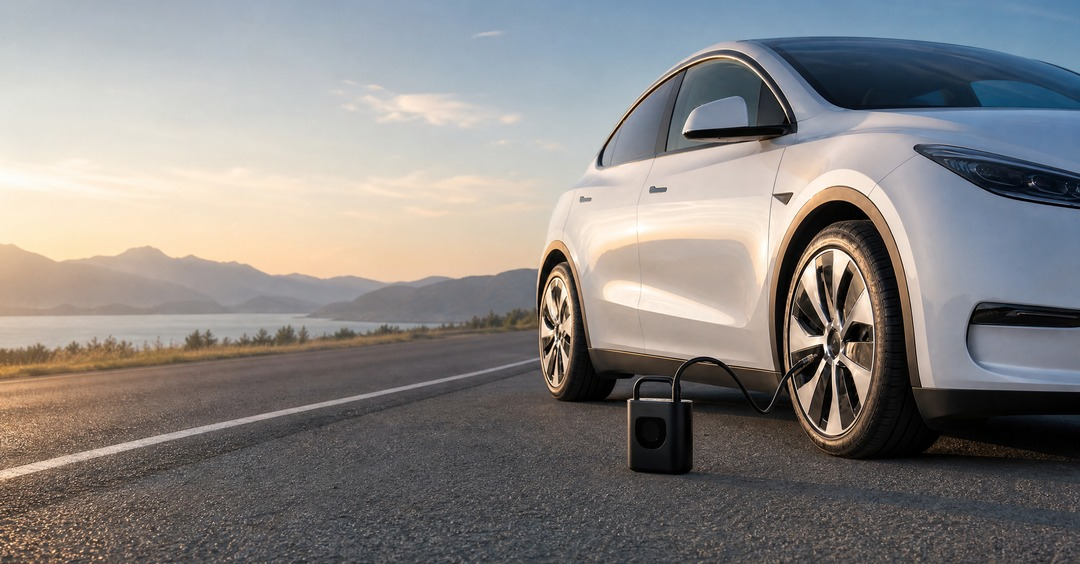
Tire pressure is one of those maintenance tasks that is easy to ignore until a warning light appears. Yet for EV drivers, keeping tires properly inflated is arguably the single cheapest efficiency improvement available: no hardware, no subscription, just a few minutes at a forecourt air pump. Under-inflated tires increase rolling resistance and rolling resistance is one of the biggest drains on your battery. Here we explain exactly how much range you can lose, how to check the numbers for your own car and how to use the EVStrada calculator to see the real-world impact on a route you drive.
01Why rolling resistance matters more in an EV
In a petrol car, rolling resistance is a relatively small slice of total energy loss: engine heat, exhaust and drivetrain friction dominate. In an EV, the drivetrain is already very efficient, so rolling resistance becomes proportionally larger. Studies from tyre manufacturers and independent testers consistently show that a 20% drop in tyre pressure increases rolling resistance by roughly 10%, which translates to around a 2–4% increase in energy consumption depending on speed and load. To put that in concrete terms: the Volkswagen e-Golf has a real-world consumption of about 153 Wh/km and a usable battery of 31.5 kWh, giving roughly 206 km of real range. A 3% consumption penalty from soft tyres cuts that to around 200 km, not catastrophic on a single trip, but compounded across weeks of commuting it adds up to noticeable extra charging costs. Check your tyre pressure at least once a month and always before a long trip. Even 0.3 bar below the recommended figure starts costing you range.
02How much range can you lose?
The relationship between tyre pressure and consumption is not linear and it varies by vehicle weight, tyre width and speed. Heavier cars press harder on the contact patch, so the effect is slightly larger in absolute terms. A lighter city EV like the Renault Twingo Electric (1,021 kg, 158 Wh/km real-world, about 135 km of usable range from its 21.3 kWh battery) loses fewer watt-hours per kilometre in absolute terms than a heavier car, but the percentage hit is similar. At motorway speeds the penalty grows because aerodynamic drag rises steeply and under-inflated tyres also deform more at speed, generating additional heat and resistance. At 110 km/h, the same 20% pressure deficit that costs 2–3% at urban speeds can cost 4–5%. For a car like the Kia EV4 Sedan Standard Range, 155 Wh/km and a 55 kWh usable battery giving around 355 km real range, a 4% motorway penalty shaves roughly 14 km off a full charge. That is the difference between making a destination comfortably and needing an unplanned stop. If you regularly drive at motorway speeds, correct tyre pressure matters even more than it does in city driving. Check before every long journey, not just monthly.
03Finding the right pressure for your EV
The recommended tyre pressure for your car is printed on a sticker inside the driver's door jamb or in the owner's manual, not on the tyre sidewall. The sidewall figure is the maximum safe pressure, not the target. Many EVs specify slightly higher pressures than equivalent petrol models because the battery pack adds a lot of weight. The Jeep Electric weighs 1,464 kg with a 50.8 kWh usable battery and a real-world consumption of 164 Wh/km; its recommended pressures account for that kerb weight and running it soft would push consumption noticeably higher. Some manufacturers provide two figures: one for normal load and a higher one for full load or towing. If you are carrying four adults and luggage, use the higher figure. Cold weather also drops tyre pressure, roughly 0.1 bar for every 10°C fall in ambient temperature, so a tyre that was correct in September may be 0.3 bar low by December. Look up your car's door-jamb sticker, not the tyre sidewall and adjust for load and season. Set a calendar reminder for the first cold morning of autumn.
04Nitrogen vs air: does it matter?
Some garages and tyre shops offer nitrogen inflation, claiming it maintains pressure more consistently than air. The science is real but modest: nitrogen molecules are slightly larger than oxygen molecules, so they permeate the rubber more slowly. In practice, the difference in pressure loss over a month is small, typically 0.01–0.02 bar and standard compressed air is 78% nitrogen anyway. For most EV owners, the practical benefit of nitrogen is not worth paying a premium for. The far bigger gains come from simply checking pressure regularly with any accurate gauge. A quality digital gauge costs under €15 and pays for itself in saved energy within weeks. If your car has a tyre pressure monitoring system (TPMS), remember that most systems only alert you when pressure is 25% or more below target: by which point you have already been losing range for some time. Use whatever air is available at your nearest forecourt, but invest in a personal digital gauge so you can check pressure accurately at home rather than relying on TPMS alerts.
05Putting it all together on a real route
Tyre pressure does not exist in isolation. It interacts with speed, temperature, payload and road gradient. That is why a flat-number percentage estimate only tells part of the story. If you are planning a trip (say, Paris → Lyon, a route with a mix of motorway and some elevation change) the real consumption will depend on all these variables together. Using the EVStrada calculator lets you model your specific car and conditions rather than relying on WLTP figures, which are measured under controlled laboratory conditions with correctly inflated tyres and a light test load. Real drivers rarely replicate those conditions. For reference, a car like the BMW i3 with 154 Wh/km and 37.9 kWh usable battery has a real-world range of around 246 km, enough for Paris to Lyon in one charge under good conditions, but marginal if tyres are soft and the car is fully loaded. Before any trip over 150 km, check tyre pressure, then run your route through the EVStrada calculator to confirm you have enough margin and to identify where you might want to stop for a top-up.
06Bottom line
Tyre pressure is the lowest-effort, lowest-cost efficiency lever available to any EV driver. Keeping tyres at the manufacturer's recommended pressure costs nothing beyond a few minutes and a cheap gauge, yet it can recover 2–5% of range that would otherwise be wasted as heat in the tyre contact patch. Over a year of regular driving, that adds up to real money and fewer charging stops. Check your pressure monthly, adjust for load and cold weather and use the EVStrada EVStrada calculator to understand how all the variables combine on your actual routes.