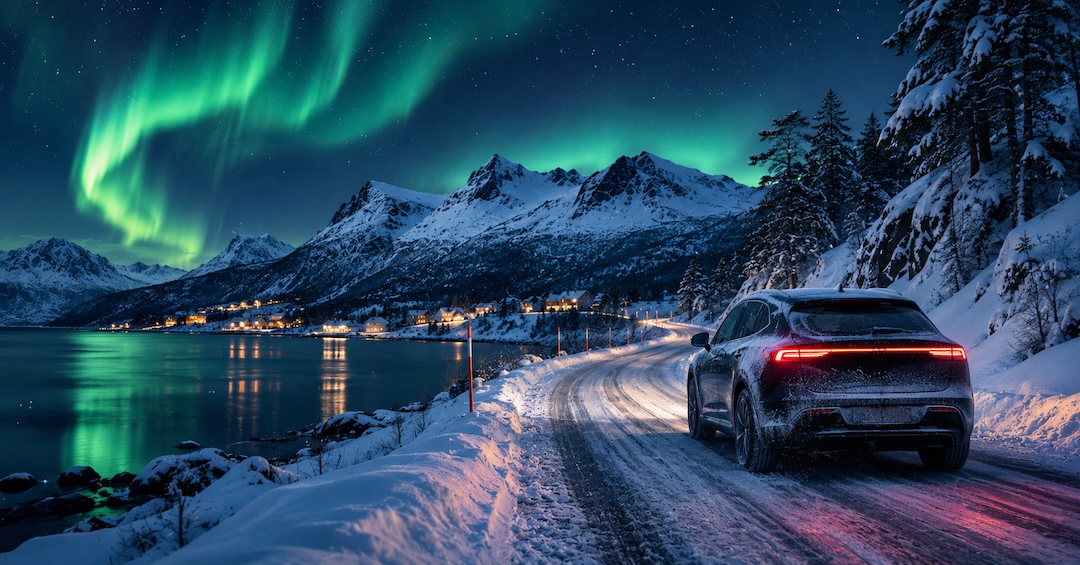
Scandinavia in winter is one of the most demanding environments you can put an electric vehicle through. Temperatures regularly drop below −10 °C, daylight is scarce and some routes push well beyond 1,000 km between major cities. That combination of cold, distance and limited charging infrastructure forces every assumption about EV range to be re-examined. Here we walk through what happens to energy consumption on long Nordic winter drives, using real route distances and real-world consumption figures: so you can plan with numbers you can trust, not best-case WLTP claims.
01Why cold weather hits EV range so hard
Lithium-ion batteries lose usable capacity as temperatures fall. Below 0 °C, internal resistance rises, which means the pack delivers less energy per charge cycle and accepts charge more slowly. On top of that, cabin heating in an EV draws directly from the traction battery: there is no waste heat from a combustion engine to recycle. A heat pump helps a lot, but even with one, heating a cold cabin in −15 °C weather can add 30–50 Wh/km to your baseline consumption depending on vehicle size and insulation. In practice, real-world consumption figures measured in temperate conditions will understate what you see in a Scandinavian January. Always treat summer real-world numbers as a floor, not a ceiling, when planning a winter trip. Use the EVStrada calculator to model your specific route and vehicle before you leave home.
02Stockholm to Kiruna: the numbers on a true Arctic run
The S → ckholm → Kiruna route covers 1,237.76 km: one of the longest purely domestic drives in Sweden and one that takes you well above the Arctic Circle. At that distance, even a large-battery vehicle will need at least one substantial charging stop and in winter conditions, possibly two. Consider the Polestar 3 Long Range Performance, which carries a 107 kWh usable battery and returns a real-world consumption of 228 Wh/km in normal conditions. In cold weather, add a conservative 40 Wh/km for heating and reduced battery efficiency and you are looking at roughly 268 Wh/km. That brings effective range down to around 399 km per full charge, meaning you would need at least two charging stops on this route even starting at 100%. Plan your stops around the larger fast-charger hubs in Sundsvall and Umeå and aim to arrive at each charger with at least 15–20% remaining to avoid cold-battery charge-rate throttling.
03Stockholm to Rovaniemi: crossing into Finnish Lapland
The S → ckholm → Rovaniemi corridor stretches 1,150.45 km and crosses into Finland, adding a border crossing and a shift in charging network. Finland's charging infrastructure has improved markedly, but density thins out noticeably north of Oulu. For a vehicle like the Ford Mach-E Er (91 kWh usable, 207 Wh/km real-world consumption) winter conditions pushing consumption to around 250 Wh/km would give you roughly 364 km of practical range. That means two charging stops are the minimum and three is a safer plan if temperatures are severe. The EVStrada calculator lets you enter a custom consumption figure, so you can dial in a winter-adjusted number rather than relying on the default. Do that before you book your ferry or accommodation, not after.
04Oslo to Copenhagen: a shorter but still demanding winter leg
Not every Scandinavian winter drive is an Arctic expedition. The Oslo → Copenhagen route covers 631.21 km: manageable in one charging stop for most modern long-range EVs, but still long enough that cold-weather range reduction matters. The XPeng G6 RWD Long Range offers 87.5 kWh usable and 182 Wh/km real-world consumption. Add a winter penalty of around 35 Wh/km and you get roughly 217 Wh/km, yielding about 403 km of effective range. That is just enough to reach Copenhagen from Oslo with one stop and careful speed management: keeping to 100 km/h rather than 120 km/h can recover 15–20% of range on a motorway run. Pre-condition the battery and cabin while still plugged in at your starting point; it costs grid electricity rather than range and makes a measurable difference on a cold morning.
05Charging strategy: slow charging, cold batteries and timing
Cold batteries charge slowly. A pack that would accept 150 kW in summer may be limited to 50–80 kW until it warms up through use or active thermal management. This means your first charging stop of the day, especially if the car sat outside overnight, will take longer than your app predicts. Practical tactics: drive 20–30 km before your first stop to let the battery warm up; use any available battery pre-conditioning feature before arriving at a charger; and target 80% rather than 100% on intermediate stops, since the final 20% charges slowly regardless of temperature. On very long routes like Stockholm to Kiruna, a 20-minute stop at 80% is almost always faster overall than waiting for 100%. The EVStrada calculator lets you model total trip time including realistic charge stops, not just driving time.
06Bottom line
A winter EV road trip in Scandinavia is entirely achievable with the right preparation. The key is accepting that real-world consumption will be noticeably higher than any WLTP figure, building extra charging stops into your plan and using tools that work from actual route distances and real consumption data rather than manufacturer best-case numbers. The routes are well-served by fast-charger networks along the main corridors and the driving itself, through snow-covered forests and long Nordic twilights, is rewarding. Plan the numbers carefully and the experience takes care of itself.