Long motorway trips are where electric cars feel most different from petrol ones. Steady high speed is the single most demanding thing you can ask of a battery, so the gap between a frugal EV and a thirsty one widens exactly when you most want range. This article ranks a set of cars from the EVStrada catalog by their real-world energy use, explains why the most efficient car is not always the one that travels farthest, and shows how charging speed changes a long trip even when range does not. You can test any of these figures against your own journey in the EVStrada calculator.
01Why the motorway is the hardest test for an EV
Aerodynamic drag grows with the square of speed, so the energy needed to push a car through the air roughly quadruples when you double your pace. Around town, drag barely matters; at a steady 120 or 130 km/h on the motorway it dominates everything else. That is why a long, fast motorway run drains a battery faster per kilometre than the same distance of mixed driving, and why the catalog's real-world consumption figures — which blend town, A-road and motorway — sit below what you will actually see at a constant high cruise. Two things help: a low, slippery body shape that cuts drag, and simply easing off the top of your cruising speed. The cars compared here, the Tesla Model 3 and Hyundai IONIQ 6, are both built around low drag, which is why they do comparatively well at speed. The practical takeaway: on a long motorway leg, dropping your cruise by 10–15 km/h is the cheapest range you will ever find.
02Efficiency ranked among these cars
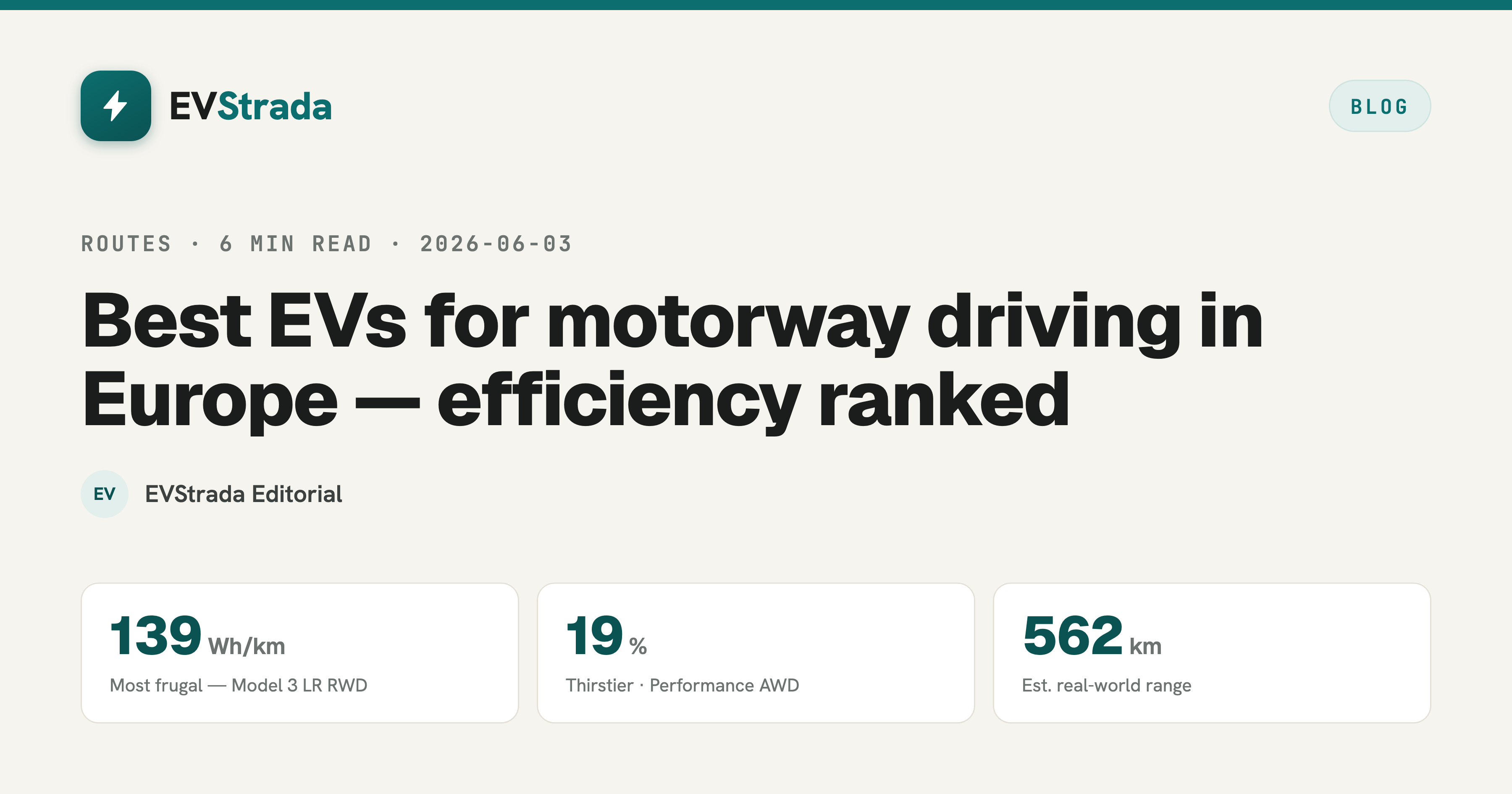
Ranked purely by the real-world consumption recorded in the catalog, the most frugal car here is the Tesla Model 3 Long Range RWD at 139 Wh/km, tied with the much smaller-battery IONIQ 6 Standard Range RWD. Close behind is the Hyundai IONIQ 6 Long Range RWD at 143 Wh/km. At the other end, the Model 3 Performance AWD uses 165 Wh/km — the same body, but heavier-footed gearing and stickier tyres cost roughly 19 percent more energy than the frugal Long Range RWD. These are mixed-driving figures, not pure motorway numbers, so every car here will draw more at a steady high cruise; what the ranking tells you is the relative order, which tends to hold as speed rises. The practical takeaway: when efficiency is your priority, the single-motor rear-wheel-drive versions are the ones to shortlist — see exactly how they compare in the table below.
Motorway efficiency ranking — most frugal first
139Wh/km
Most frugal · Tesla Model 3
19%
More energy · thirstiest vs frugal
561.9km
Longest est. real range
Estimated range at a steady cruise
Estimate only — a steady-cruise model derived from each car’s mixed catalog figure (drag ∝ speed²). Real trips vary with wind, temperature, payload and elevation.
| Variant | |||||
|---|---|---|---|---|---|
| Tesla Model 3Long Range RWDMost frugal | 78.1 | 139 | 702 | 562 | 170 |
| Hyundai IONIQ 6Standard Range RWD | 51 | 139 | 429 | 367 | 175 |
| Hyundai IONIQ 6Long Range RWD | 74 | 143 | 614 | 517 | 233 |
| Tesla Model 3RWD | 57.5 | 148 | 513 | 389 | 170 |
| Hyundai IONIQ 6Long Range AWD | 74 | 151 | 583 | 490 | 233 |
| Tesla Model 3Long Range AWD | 78.1 | 152 | 629 | 514 | 250 |
| Tesla Model 3Performance AWD | 78.1 | 165 | 528 | 473 | 250 |
Sorted by real-world consumption (lowest first). Estimated real-world range is usable battery divided by the catalog's real-world consumption; WLTP is the manufacturer-rated figure. These consumption numbers reflect mixed driving, so a steady motorway cruise will push every car higher — treat the order as the reliable part and the absolute ranges as a guide.
03RWD versus AWD: the efficiency you pay for grip
The catalog shows a consistent penalty for the second motor. The Tesla Model 3 Long Range drops from 139 Wh/km in rear-wheel-drive form to 152 Wh/km as all-wheel drive — about 9 percent more energy for the same battery. The IONIQ 6 Long Range follows the same pattern, rising from 143 to 151 Wh/km between RWD and AWD. All-wheel drive buys you traction in snow and rain and quicker acceleration, but on a dry motorway in summer that second motor mostly adds weight and drag for range you rarely use. On the estimated real-world figures, the Model 3 Long Range RWD travels around 562 km against roughly 514 km for the AWD version of the same car — a meaningful difference on a long trip. The practical takeaway: if your driving is mostly motorway and mild-climate, the rear-wheel-drive version will go noticeably farther between charges; choose AWD only if you genuinely need the grip.
04A small battery undoes good efficiency
Efficiency and range are not the same thing. The Hyundai IONIQ 6 Standard Range RWD matches the most efficient car here at 139 Wh/km, yet its 51.0 kWh usable battery gives an estimated real-world range of only about 367 km — because range is simply usable energy divided by consumption. The Long Range version of the same car, slightly less efficient at 143 Wh/km, carries 74.0 kWh usable and reaches roughly 517 km. The frugal-but-small car will need more stops on a long run even though it sips energy. For motorway distance you want a low consumption figure and a large usable battery together, which is why the Model 3 Long Range RWD — 139 Wh/km paired with 78.1 kWh — tops the estimated-range column at about 562 km. The practical takeaway: judge a motorway car by its estimated real-world range, not its Wh/km alone, and confirm the number for your route in the EVStrada calculator.
05Charging speed decides your trip time, not your range
On a journey long enough to need a charge, how fast the car refills matters as much as how far it goes. Here the efficient Model 3 Long Range RWD is capped at 170 kW, while the Hyundai IONIQ 6 Long Range variants accept up to 233 kW thanks to their higher-voltage system. That gap will not change your range, but it can shorten each stop on a multi-charge trip, so the most efficient car is not automatically the one that finishes a long route quickest. The Model 3 Long Range AWD and Performance, by contrast, take up to 250 kW. On a route such as Madrid → Barcelona, a single fast top-up is often enough, but on longer chains the charging rate compounds across every stop. The practical takeaway: for frequent long trips, weigh charging speed alongside range — a slightly thirstier car that charges faster can still get you there sooner.
06Bottom line
For motorway driving, the cars that do best combine a low-drag shape, modest energy use and a large usable battery. In this catalog the rear-wheel-drive single-motor versions lead on efficiency, and the Model 3 Long Range RWD pairs the lowest consumption with the biggest range — though the IONIQ 6 Long Range answers back with much faster charging. Efficiency, battery size and charging speed each pull in a slightly different direction, so the right choice depends on whether you optimise for fewer stops or shorter ones. Match the numbers to your own journeys in the EVStrada calculator before you decide.