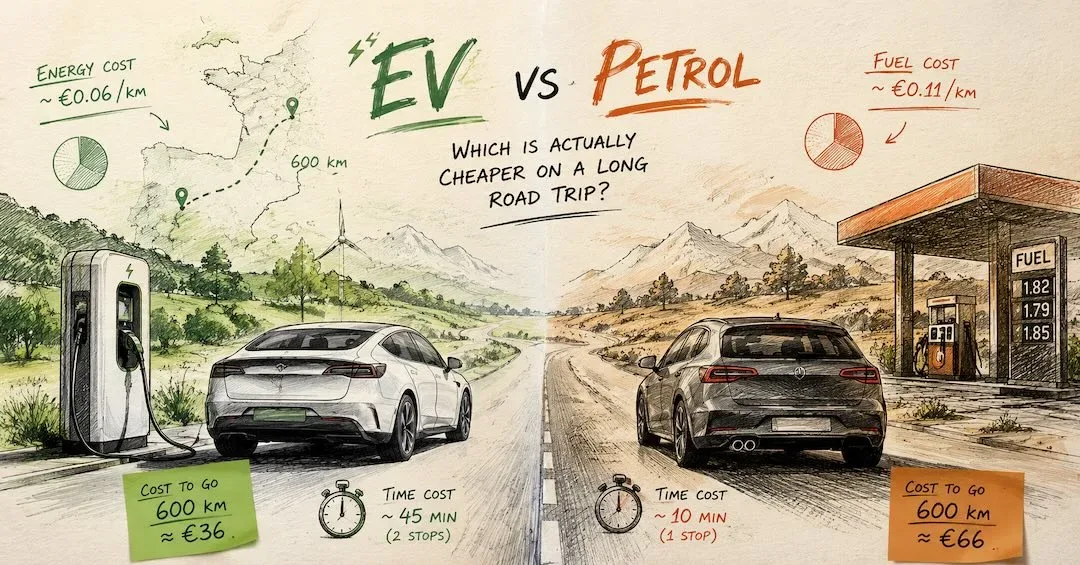
Everyone knows EVs are cheaper to run around town. But what happens on a proper long road trip: say, 600 km across France or down through Spain? Charging stops, motorway speeds and variable electricity prices all complicate the picture. Here we break down the real numbers: energy costs per kilometre, the hidden time cost of charging and how to calculate what your specific route will cost before you leave home.
01The basic maths: energy cost per kilometre
Petrol in Europe currently averages around €1.70–€1.90 per litre depending on country and a typical family hatchback doing motorway driving uses roughly 7–8 litres per 100 km. That works out to about €12–€15 per 100 km in fuel alone. On the EV side, the numbers depend heavily on which car you drive and where you charge. Take the Tesla 3 Standard Range Plus: its real-world consumption sits at 146 Wh/km. At a public fast-charger pricing of €0.55 per kWh, common across European motorway networks, that's roughly €8 per 100 km. Charge at home on a night tariff of €0.12/kWh and the same distance costs under €1.80. The gap between home charging and public charging is enormous and it's the single most important variable in any EV road-trip cost calculation. Before your next trip, use the EVStrada calculator to see what your specific car and route will cost at current energy prices.
02How real-world consumption changes at motorway speeds
WLTP range figures are measured on a mixed cycle that includes a lot of low-speed driving. On a motorway at 120 km/h, consumption rises sharply. The Mini Aceman has a real-world consumption figure of 170 Wh/km in mixed conditions; push it to sustained motorway speeds and expect that to climb toward 200–210 Wh/km, cutting its usable 49.2 kWh battery's effective range from around 289 km to closer than 240 km between stops. The Mini Cooper E, which is lighter at 1,252 kg and uses 146 Wh/km in mixed driving, fares better proportionally on the motorway simply because less weight means less energy needed to maintain speed. Headwinds, rain and altitude changes all add further consumption. A tool like the EVStrada calculator accounts for route elevation and typical weather, which flat Wh/km averages cannot. Always plan your charging stops around real-world figures, not the WLTP number on the window sticker.
03Charging stops: the real time cost
A petrol fill-up takes about five minutes. A charging stop on a long EV trip is a different proposition and how long it takes depends on the car's maximum DC charge rate and the charger's output. For many cars in the EVStrada catalog, maximum DC charge rates are still being confirmed: so it pays to check your specific model before you go. In practice, most drivers plan stops of 20–30 minutes at 150 kW+ chargers, which is enough to add 150–200 km of real range to a mid-size EV. On a 700 km trip like Paris → Lyon → Marseille, a single well-timed stop is usually sufficient for an efficient car. The Opel / Vauxhall Sports Tourer Electric, with its 50.8 kWh usable battery and 164 Wh/km consumption, delivers around 310 km of real range, meaning one stop covers most long French routes comfortably. Plan your stops at locations with multiple chargers to avoid queues and use the EVStrada calculator to identify the optimal stop point for your route.
04Van-based EVs and people carriers: a different calculation
Not everyone is doing a road trip in a compact hatchback. Families in larger vehicles face a steeper efficiency penalty. The Renault Kangoo Grand E-Tech Electric uses 205 Wh/km in real-world conditions on its 45 kWh usable battery, giving roughly 220 km of practical range. The Nissan Townstar EV Passenger is similar at 200 Wh/km with the same 45 kWh usable capacity: also around 225 km between charges. For these vehicles, a 600 km trip means at least two charging stops and the cost advantage over diesel narrows because you're buying more kWh per kilometre. A diesel people-carrier doing 6.5 litres per 100 km at €1.75/litre costs about €11.40 per 100 km. The Kangoo at 205 Wh/km on a €0.55/kWh public charger costs about €11.30 per 100 km: essentially the same. The EV advantage only materialises clearly if you can charge partly at home or at a destination with cheaper electricity. Run your actual route through the EVStrada calculator to see where the break-even point falls for your vehicle.
05Where EVs clearly win and where they don't
EVs win most convincingly on trips where you can start with a full charge from home, the route is under 400 km and you have access to at least one reasonably priced en-route charger. An efficient car like the Tesla 3 Standard Range Plus (146 Wh/km, 51 kWh usable) can cover around 349 km on a single charge in mixed conditions, making many European city-to-city trips charge-free. EVs are less competitive when you rely entirely on premium motorway chargers at €0.60–€0.70/kWh, drive a heavier or less efficient vehicle or face a route with big elevation gain that isn't offset by regenerative braking on the descent. In those scenarios, the cost gap versus a modern diesel can shrink to near zero or even reverse. The honest answer is that 'cheaper' depends entirely on your car, your route and where you charge, which is exactly why a route-specific calculator matters more than any general rule of thumb.
06Bottom line
On most long European road trips, a reasonably efficient EV charged at a mix of home and public points will cost 30–50% less per kilometre than a comparable petrol car. That advantage compresses when you rely on premium fast-chargers and expands when you have access to cheap overnight electricity. The variables (vehicle efficiency, charging price, route elevation, speed) interact in ways that make general comparisons unreliable. The most useful thing you can do before any long trip is run your actual route through a tool that uses real consumption data, not manufacturer estimates.